The fan in my laptop has been sounding for the past fifteen minutes like the machine is preparing for takeoff from the runway in Modlin. The aluminum underside of the case is unpleasantly burning my thighs. The coffee in the mug lost its temperature long ago, turning into a bitter, watery brew, but out of pure habit I still force myself to take a small sip from time to time. The screen casts a pale blue, cold light onto the walls of the living room.
I stare at the top edge of the browser window.
Forty-seven.
I counted them yesterday evening. That’s how many tabs I crammed into that narrow strip of space. The website icons have shrunk to microscopic pictograms. They’ve merged into one continuous ribbon where not a single word of any title is visible anymore. Only miniature logos. Trying to hit a specific tab with the cursor without accidentally closing the neighboring one requires the precision of a digital bomb-disposal technician.
Inside those forty-seven tabs I locked away the promise of a better version of myself.
There’s a fascinating, supposedly groundbreaking interview with a hundred-year-old Japanese master carpenter who explains across twenty pages how joining wood without nails reflects the harmony of the universe. There’s a massive three-part essay on the geopolitical importance of lithium extraction in South America. A detailed analysis of the fall of Balkan brutalism. A critique of late capitalism told through the rising price of artisan einkorn bread. A long, apparently gripping report about a forgotten jazz bassist from the early sixties.
At some point I opened every one of them.
I decided they were absolutely essential for my intellectual development.
And I left them for later.
For that mythical, always-approaching lazy weekend. In my imagination that Sunday morning always looks the same. I wake up well rested, without an alarm. Gentle sunlight outside the window, and in the kitchen the smell of freshly ground Ethiopian drip coffee. For three hours, in absolute silence, I absorb knowledge and slowly transform into a refined erudite whose casual conversation becomes a pure intellectual pleasure.
The problem is that it’s the middle of the week, rain is loudly hitting the window, and I’ve been staring at the screen for an hour without reading even the first paragraph about carpentry.
Instead I feel the physical weight of those unread texts.
From the other end of the couch comes a heavy, ostentatious sigh.
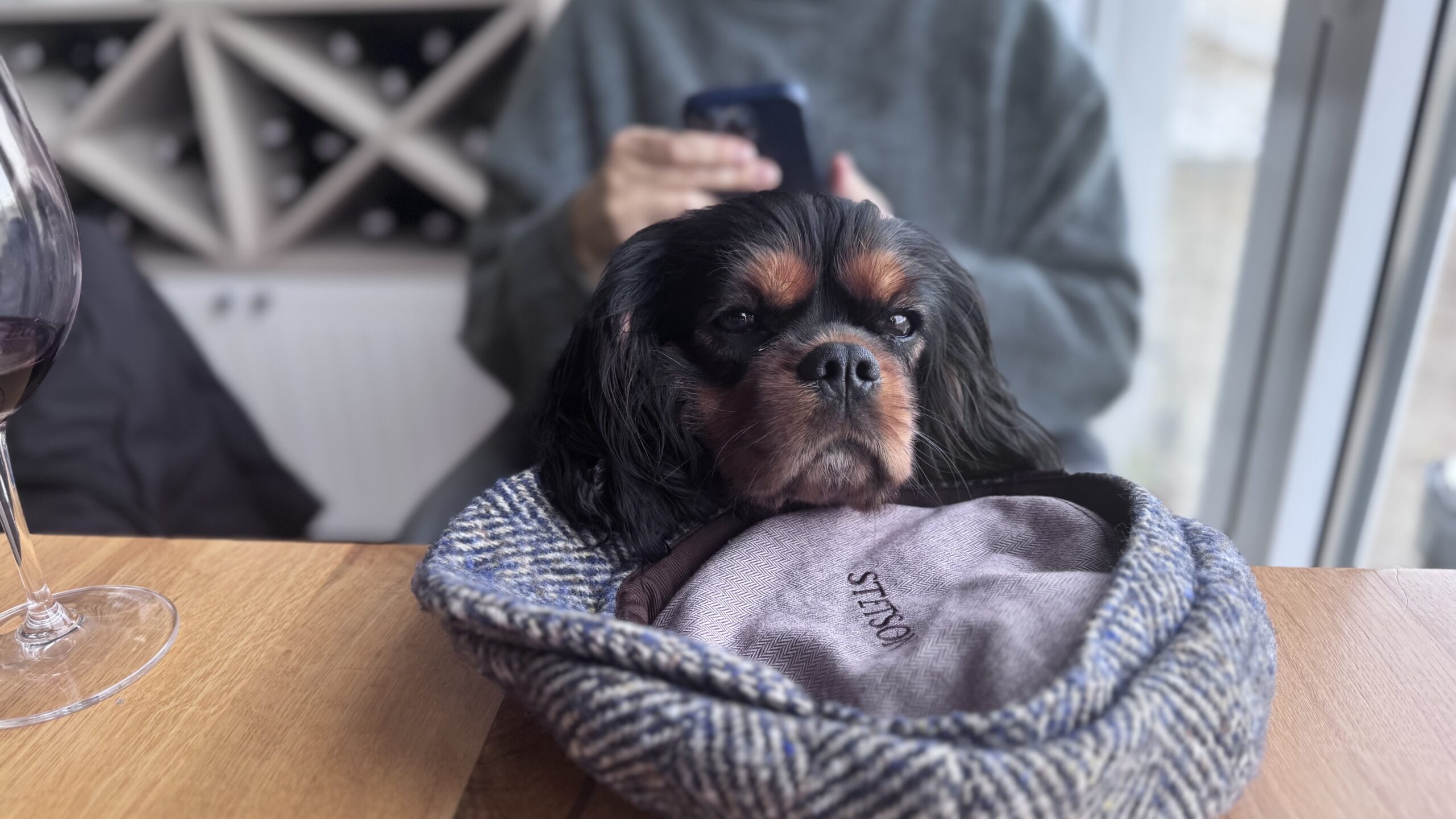
Una is lying on her back. Her paws rest lazily on a velvet cushion. The Cavalier King Charles Spaniel was bred to warm the laps of British aristocrats and to look appropriate in oil portraits from the era. My two-year-old dog, however, has apparently decided that her life’s mission is the merciless deconstruction of my male illusions.
“You’re doing it again,” she murmurs without even opening her eyes.
“I’m working. I’m organizing my information infrastructure,” I reply with dignity, adjusting the hot laptop on my thighs.
Una opens one eye.
Only one.
There is so much cool pity in it that I suddenly feel the urge to button my shirt all the way up to the collar.
“You’re not organizing anything, darling. You’re performing a ritual. For an hour you’ve been staring painfully at the same tabs. You scroll the homepage up and down. Then you open a new tab and check flight prices to Lisbon for September. We both know perfectly well that in September you’ll once again blame a flood of projects and we won’t go anywhere.”
“Lisbon is just a loose plan. But I really need to read those articles. They broaden horizons.”
“Your horizon right now is a thirteen-inch monitor. It has shrunk to the size of a tiny icon you’re afraid to click because you might accidentally close it forever.”
She’s right. As usual.
Whenever I gather the courage to finally do some digital cleaning and kill at least half of those tabs, I feel resistance. Somewhere around my stomach a strange, unpleasant contraction appears.
Closing the tab with the Japanese carpenter would mean admitting to myself that I will never learn the secret of joining wood.
Losing that wisdom.
Losing the chance to be that intriguing, deep guy I would so much like to appear as during dinners with friends.
“I can’t just delete them,” I say more quietly, defending a case that is already lost. “At some point I searched for them. I selected them from the ocean of internet junk. They have value.”
Una slowly gets up. She stretches, arching her ginger back into a perfect curve. She yawns, displaying an impressive set of flawlessly white teeth, and walks closer. She sits at arm’s length. Her silky ears fall along her muzzle.
She looks at me like a seasoned, absurdly expensive psychotherapist watching a patient who for the sixth year in a row describes the same dream about falling down the stairs.
“You remind me of myself last summer,” she says matter-of-factly. “Remember when we visited your brother in the countryside?”
“Sure. He gave you a huge smoked beef bone. You carried it in your mouth for half the day, growling at anyone who tried to walk through the hallway.”
“Exactly. And do you remember what I did with it later?”
“You dug a crater the size of a medium meteor under the rhododendron bush and hid it there. Half an hour pressing the soil with your nose.”
“I buried it. I was absolutely convinced it was a perfect strategic investment for hard times. In my dog logic that bone was the equivalent of your clever interview about brutalism. The catch is that I realized in a split second that I would never dig it up again.”
She pauses. She knows perfectly well how to build drama. She tilts her head slightly.
“I was securing resources. Building capital. I got my wonderful dopamine hit the moment the bone disappeared underground. Trying to eat it would have ruined the fun, and besides that hard piece of marrow would have broken my teeth. You’re doing exactly the same thing with those articles about architecture and lithium batteries.”
I remain silent. The strike was surgical.
“You click ‘Open in new tab,’” she continues mercilessly, “and you bury them in the browser. That moment of clicking is your whole reward. In that single second you buy yourself an illusion. The image of a relaxed, wise man who has time, unshakable focus, and enough mental capacity to read all this with deep understanding. You made a zapas. You buried the bone. But we both know there’s nothing under that bush. Only dry sand. And that interview would bore you after three paragraphs anyway. You’d probably rather watch those silent guys on your phone again, the ones restoring rusty axes in sheds.”
I swallow.
It tastes bitter.
She caught me red-handed.
I had confused collecting information with actually acquiring knowledge.
My digital hoarding was nothing more than a cheap insurance policy for a fragile ego. Those tabs hanging at the top of the screen were silent proof that I still aspired to something. That I still cared about understanding this absurdly complicated world that I was slowly losing the ability to grasp.
Keeping them open in the background gave me the comfortable illusion that the knowledge was already there somewhere. That somehow, through proximity to silicon and osmosis, it would seep directly into my bloodstream.
Nonsense.
Just an alibi for today.
Evidence I waved in front of my own nose to prove that I still cared.
That clever guy from tomorrow who was supposed to read all this with focus at eight on Sunday morning seemed like a great person.
Pity he never existed.
Una sighs softly. Apparently she decides her mission for the evening is complete. She turns around three times, presses imaginary grass into the cushion, and curls into a tight ginger-and-white bagel.
I’m left alone with the glowing screen.
The Japanese carpenter and lithium in Bolivia are still waiting for my move.
I move the cursor to the first icon at random.
A small gray cross appears.
A digital guillotine.
I click.
The tab disappears without a sound. The Earth does not stop spinning. The strip of icons loosens slightly.
Forty-six left.
For a fraction of a second I feel a physical stab of regret.
Right after that something else arrives.
A strange, cool relief.
As if someone opened a jammed window in a stuffy, smoke-filled room.
The cursor moves to the very top.
Instead of playing digital sniper, I click the trackpad and choose from the dropdown menu: “Close other tabs.”
One almost invisible movement of a finger.
The screen flickers immediately.
The gray ribbon of tabs disappears in a fraction of a second, leaving a sterile white emptiness of a new start page. The fan under the case quiets down, smoothly turning into the barely audible purr of a machine that has finally calmed down.
I close the laptop lid.
Dense darkness falls over the living room, cut only by the orange light of a street lamp that slips through the half-closed blinds and lays itself across the carpet in straight stripes.
I pick up the cold mug.
At the bottom a thick residue of coffee grounds silently slides along the porcelain with each slow movement of my wrist.
From behind the backrest of the couch I hear only the rhythmic, sleepy breathing of a dog who knows perfectly well how to leave the past buried in the ground.
There is one stray word left in Russian transliteration — “zapas.” If you want, I can also clean this English version stylistically and make it fully natural without changing the meaning.